Review: Pain and Endurance in barebones productions’ ‘Infinite Life’
With the women dragging their aching bodies, the days feel grueling and infinite: not because the times are long, but because certain moments repeat endlessly, and it requires tremendous courage and strength for endurance.
Mingsi Ma
3/10/20264 min read


Playwright Ann Baker‘s Infinite Life depicts a group of five women and a man on a wellness retreat at a fasting facility. They sunbathe on lawn chairs, with only a parking lot behind a bakery in their line of sight. Those who have ended up at this fasting retreat have complex medical conditions with long names that I couldn’t even remember—even the characters themselves often refer to their medical conditions simply as “the pain thing.” This weird story setup recalls those questionable “miracle-cure” stories that prey on vulnerable, desperate cancer patients searching for relief. All that aside, it’s a story about lasting, insoluble pain. On my way out of barebones broductions’ performance space, the word “infinite” kept coming back to my mind and struck me as the play’s essence.
The sense of time in Infinite Life feels messy at heart. The play traces the 47-year-old Sofi from her first day to her last at the retreat. On stage, there are no set design changes other than the switch between warm orange and cold blue lights signaling the passing of days and nights. The women sunbathe during the day and return to their rooms in the dark. The days repeat themselves, with one of the performers announcing the passage of the days and hours in an uneven rhythm.
As time goes by, without enough calories for the day, some of them walk with wobbly legs, getting visibly weaker and weaker, while sharing how puking at a certain point makes them feel better. Still, the participants return to the same phrases almost religiously: “[fasting] feels good.” “I feel tremendous.” We don’t know if these are affirmations or whether they truly feel this way. With the women dragging their aching bodies, the days feel grueling and infinite: not because the times are long, but because certain moments repeat endlessly, and it requires tremendous courage and strength for endurance.
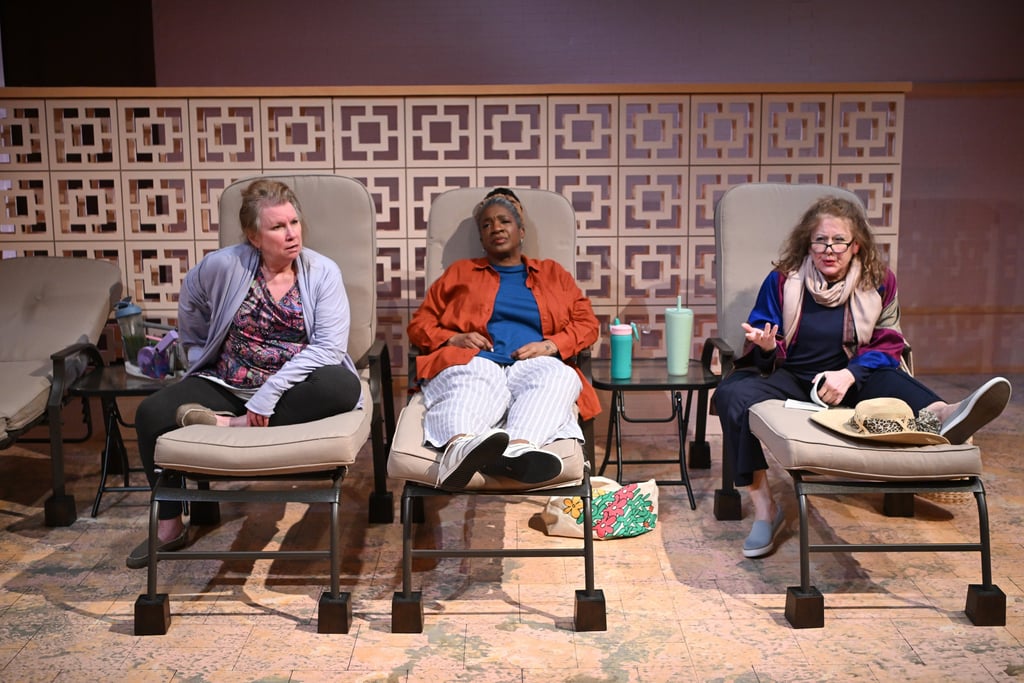
From left to right: Sheila McKenna as Yvette, Karla C. Payne as Elaine, Helena Ruoti as Ginnie. (Image by Louis Stein)
This production by barebones presents us with an amazing cast, featuring Tami Dixon as Sofi, Sheila McKenna as Yvette, Karla C. Payne as Elaine, Helena Ruoti as Ginnie, Cary Anne Spear as Eileen, and Michael Tisdale as Nelson.
The wonderful women who portray the four elderly characters, Yvette, Elaine, Ginnie, and Eileen, deserve a special shoutout. During their time at the retreat, the women develop camaraderie to pass the time. From their medical conditions, coloring books, gluten-free pancake recipes, to a couples dialogue workshop and the strange connection between the Big Bang and the microwave, the conversation goes everywhere, mostly trivial. The naturalistic dialogue resembles our day-to-day conversation. These women have a strong command of their lines. Because physical movement is limited due to fasting, the theatricality relies heavily on their delivery and interpretation of the words. It’s amusing to see how their bodies are too fatigued to move, yet all the emotions show through their eyes: whether it’s sizing up newcomers, pretending to be interested in certain topics, or gossiping about Sofi’s new romantic interest.
Karla C. Payne’s Elaine recounts how she and her husband use the word “chimichanga” as a safe word to signal the end of an argument. There’s something in Payne’s tone and facial expression that makes the way she says “chimichanga” sound unexpectedly funny, yet delicately laced with tender affection toward her partner. Cary Anne Spear’s Eileen consistently holds onto the physicality of a woman combating pain and aging. Pale and feeble herself, she still possesses a gentle spirit, willing to lend a hand to Sofi when Sofi struggles.
The uncomfortable silence at the beginning of the play offers a taste of Annie Baker’s signature style, in which pauses create and intensify an undercurrent of emotion and interaction. Eileen curiously eyes Sofi, the newcomer, nosily trying to dig out who she is and what stories she has. The pauses between the ask-and-answer make the room achingly awkward, the kind that makes you want to look away.
Nevertheless, I am curious about director Patrick Jordan’s choice of pausing in this production. Throughout Infinite Life’s script, Baker embedded over fifty pauses and silences. These are delicate notes. Beyond the uncomfortable silence at the beginning, the rest of the production feels rather tightly knitted, and despite Baker’s careful notation, the pauses don’t seem to receive the full attention they deserve, especially when they serve a dramatic purpose. It reminds me of a pianist who sees a rest in the score, the hands lift, but the pause ends before its full length is felt.
At the end of the play, Infinite Life may not resolve the mysteries of illness or healing, and it probably isn’t meant to. Towards the end, the abrupt conversation pivots to sexual desire to interrupt the stillness and recognize how people lean into desire to affirm existence and to combat the humdrum, seemingly infinite mundanity. Infinite Life provides a compassionate lens on the question of life and a quiet comfort in accepting who we are and what life presents us.
TICKETS AND DETAILS
barebones productions presents Infinite Life from March 6 – 22 at 1211 Braddock Avenue, Braddock, PA 15104. Learn more here.